

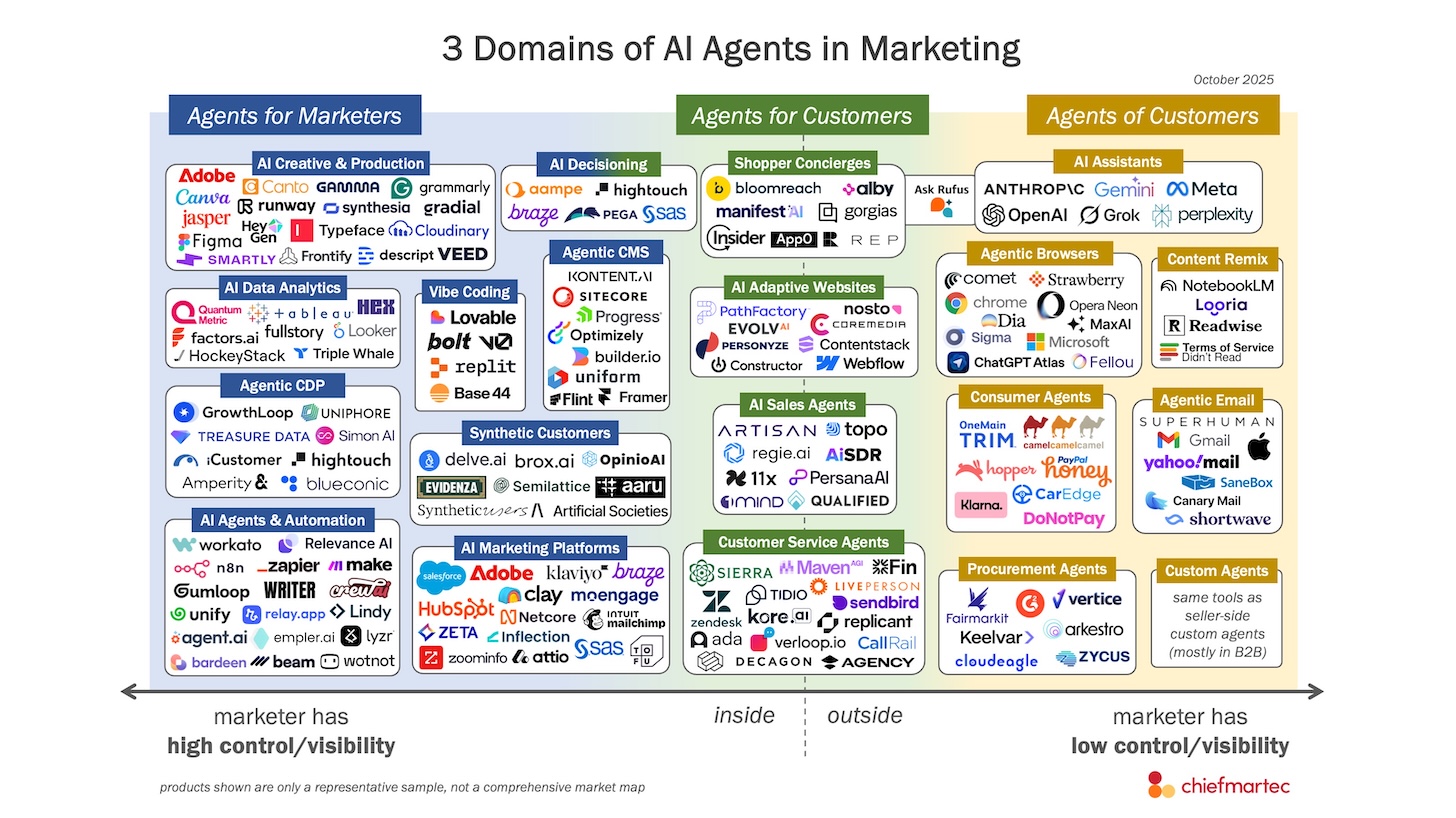
This webinar features industry expert Scott Brinker discussing the disruption of the MarTech (Marketing Technology) landscape caused by the rise of Agentic AI. The discussion focuses on three specific domains of AI agents and their impact on marketing operations and strategy.
Key Domains of AI Agents:
1. Agents for Marketers (0:04:00 – 0:07:25): These tools assist marketing teams behind the scenes with brainstorming, content production, data analysis, and campaign assembly. While widely adopted for enhancing efficiency, Brinker notes that governance and orchestration are becoming essential as teams begin to scale these deployments
2. Agents for Customers (0:40:00 – 0:43:00): These are marketer-controlled AI systems that interact directly with customers (e.g., AI chatbots, customer service agents, and inbound SDRs). The discussion highlights the balance between automation and maintaining human trust.
3. Agents of Customers (0:07:25 – 0:07:53, 0:59:30 – 1:00:18): Described by Brinker as the most disruptive domain, these are buyer-side AI agents (such as Atlas or Comet) used by customers to research, evaluate, and potentially purchase products outside of a brand’s direct control.
Strategic Takeaways:
- Data Governance: A consistent theme throughout the session is that AI’s effectiveness is entirely dependent on the quality and organization of underlying data. Brinker emphasizes the importance of a “universal data layer” (like Snowflake) to support effective agentic workflows (0:34:53 – 0:36:00, 0:48:35 – 0:50:20).
- Orchestration: As teams start to “go wild” with AI tools, the need for an orchestration layer to enforce brand standards and guardrails is critical to prevent fragmentation and “slop” (0:23:42 – 0:26:45).
- The Future of Marketing: The session concludes that the most successful marketers will stop fighting the shift toward buyer-side AI and instead learn how to support and influence these agents to build trust and effectively serve the customer journey (0:59:30 – 1:00:18).